Under cabinet lighting transforms a kitchen from functional to exceptional. Puck lights, those small, hockey-puck-shaped fixtures, offer one of the most versatile ways to illuminate countertops, reduce shadows, and add ambiance without a full electrical overhaul. They’re cost-effective, surprisingly easy to install, and available in configurations that fit nearly any cabinet setup. Whether someone’s prepping ingredients for dinner or showcasing a tile backsplash, well-placed puck lights deliver focused task lighting exactly where it’s needed. This guide walks through everything from choosing the right type to avoiding installation pitfalls that leave dark spots or visible wiring.
Table of Contents
ToggleKey Takeaways
- Under cabinet puck lighting eliminates shadows and task-light challenges by mounting compact fixtures directly above countertops, making meal prep and recipe reading safer and easier.
- LED pucks offer 50,000-hour lifespans, minimal heat output, and $15–$30 upfront costs that offset through energy savings compared to halogen alternatives.
- Proper spacing of puck lights at 12–18 inches apart center-to-center, combined with positioning 2–3 inches back from the cabinet edge, ensures uniform countertop illumination without glare.
- Three installation options—hardwired, plug-in, and battery-operated—let homeowners choose based on flexibility needs and electrical accessibility, from permanent solutions to renter-friendly adhesive mounts.
- Surface prep, wire gauge matching, transformer capacity verification, and color temperature consistency prevent common installation failures that lead to flickering, dim spots, or premature puck failure.
What Is Under Cabinet Puck Lighting and How Does It Work?
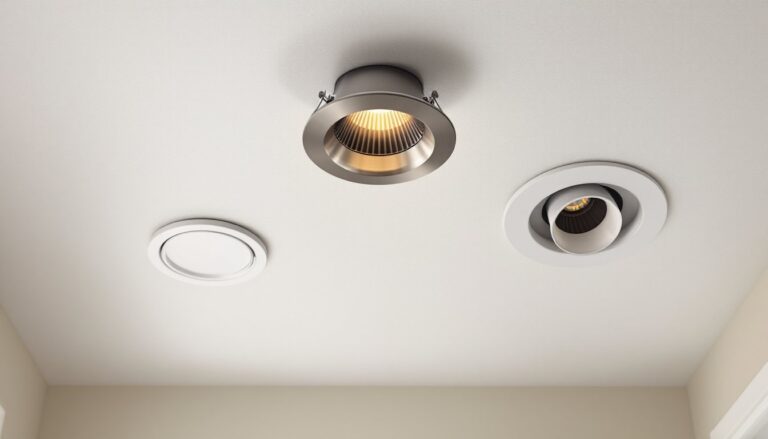
Puck lights are compact, circular or square fixtures typically 2 to 4 inches in diameter that mount to the underside of wall cabinets. Each unit houses an LED array or halogen bulb behind a diffuser lens, directing light downward onto the countertop. They’re called “pucks” because their low-profile shape resembles a hockey puck.
Most puck lights connect in one of three ways: hardwired into household electrical, plug-in to a standard outlet, or battery-operated with AA or AAA cells. Hardwired systems tie into the home’s circuit, often controlled by a wall switch. Plug-in versions daisy-chain together with low-voltage connectors and terminate at a wall transformer. Battery models offer the most flexibility for renters or retrofits but require periodic battery swaps.
LEDs dominate the market in 2026 due to energy efficiency and cool operation. Halogen pucks still appear in older stock but generate significant heat, important when cabinets store flammable items like paper towels or cooking oils. Most LED pucks run on 12V DC, stepping down from 120V AC through a transformer, while battery units operate at 3V or 6V depending on cell count.
Key Benefits of Installing Puck Lights Under Your Cabinets
Task lighting tops the list. Overhead fixtures cast shadows when someone stands at the counter, making chopping or reading recipes harder. Puck lights eliminate that shadow by placing the source directly above the work surface.
Energy savings come naturally with LED pucks. A typical LED puck draws 2 to 3 watts, compared to 20 watts for an equivalent halogen. Over a year of daily use, the difference adds up, especially in kitchens where lights stay on during meal prep and cleanup.
They also boost resale appeal. Buyers notice upgraded lighting during walkthroughs, and under-cabinet systems signal attention to detail. According to design trends observed on Houzz, well-lit kitchens photograph better and feel more modern, which can shorten time on market.
Flexibility matters for renters or anyone avoiding drywall surgery. Battery-powered pucks stick to cabinet bottoms with adhesive pads, leaving zero trace when removed. Plug-in models only require access to an outlet, making them ideal for kitchens without dedicated undercabinet wiring.
Choosing the Right Puck Lights: LED vs. Halogen and Wired vs. Battery-Operated
LED vs. Halogen
LED pucks offer 50,000-hour lifespans, negligible heat output, and color temperatures ranging from warm 2700K to cool 5000K. They cost more upfront, expect $15 to $30 per puck, but the energy savings and longevity offset the premium. Look for units with a CRI (Color Rendering Index) above 90 if accurate color perception matters for cooking or design work.
Halogen pucks produce warm, incandescent-like light at 2900K and cost less initially ($8 to $15 each), but bulbs burn out in 2,000 to 3,000 hours and generate enough heat to warp plastic storage containers placed directly underneath. They’re best reserved for accent lighting in low-use areas, not primary task lighting.
Wired vs. Battery-Operated
Hardwired systems integrate cleanly with existing switches and eliminate battery maintenance. Installation requires basic electrical skills, connecting hot, neutral, and ground wires inside a junction box, and may need a permit depending on jurisdiction. The National Electrical Code (NEC) allows low-voltage systems under cabinets without conduit if the transformer is listed and the wire gauge matches the load.
Plug-in kits balance convenience and permanence. They ship with a transformer, interconnect cables, and multiple pucks, making them popular for DIY installs. The transformer plugs into a standard outlet, often hidden behind the refrigerator or inside a cabinet with a drilled access hole.
Battery-operated pucks shine in rentals or spots far from outlets. Lithium AA cells last 50 to 100 hours of continuous use: alkaline cells fade faster. Some models include motion sensors or timers to conserve power. Expect to replace batteries every few months with regular use.
How to Plan Your Puck Light Layout for Even Coverage
Spacing determines whether the counter receives uniform light or zebra-striped pools. A common rule: place pucks 12 to 18 inches apart for general task lighting, measured center-to-center. Tighter spacing (8 to 12 inches) works for display cabinets or areas needing brighter illumination.
Position pucks 2 to 3 inches back from the cabinet’s front edge. Too far forward and light spills into the user’s eyes: too far back and the beam misses the front half of the counter. If the cabinet has a face frame, mount pucks to the underside of the cabinet floor, not the frame itself, to avoid shadows.
For long runs, say, a 10-foot galley kitchen, a mix of puck lights and linear LED strips often yields better results. Reviews of under-cabinet lighting options frequently highlight that strips eliminate the scalloped effect pucks can create at standard spacing. But pucks excel in shorter sections (under a 30-inch microwave cabinet, for example) or where the homeowner wants adjustable accent lighting.
Draw the layout on paper before drilling. Mark stud or cabinet frame locations with a stud finder to avoid screwing into empty space. If using adhesive-mount pucks, clean the surface with isopropyl alcohol and let it dry completely, grease or dust kills adhesion.
Step-by-Step Installation Guide for Under Cabinet Puck Lighting
Safety First: Turn off power at the breaker for hardwired installs. Wear safety glasses when drilling overhead to keep dust and splinters out of eyes.
Hardwired Installation
- Run cable from the switch box to the first puck location. Use 14/2 NM-B (Romex) for 15-amp circuits or 12/2 for 20-amp. Secure cable every 4.5 feet with staples, keeping it at least 1.25 inches from the cabinet edge per NEC 334.15.
- Mount the transformer inside the cabinet or in the wall cavity behind it. Connect line voltage (black and white wires) to the input terminals, following manufacturer instructions.
- Drill puck mounting holes using the template provided. A 5/8-inch spade bit works for most low-voltage wire pass-throughs.
- Daisy-chain pucks with the supplied interconnect cables, snapping connectors into each fixture. The last puck in the run typically has a cap or terminator.
- Secure pucks with screws (usually #6 x 3/4-inch pan-head) into pilot holes. If mounting to particleboard, use toggle anchors or specialized cabinet screws to prevent stripping.
- Test the circuit before closing up. Flip the breaker, toggle the switch, and check for even illumination. Dim or flickering lights suggest a loose connection.
Plug-In Installation
- Plan the cable route to the nearest outlet. Some kits include raceway channels to conceal wires along the cabinet bottom or wall.
- Attach pucks as above, connecting each with low-voltage cables.
- Plug in the transformer. If the outlet sits behind an appliance, ensure the cord doesn’t create a pinch point or fire hazard.
Battery-Operated Installation
- Peel the adhesive backing and press each puck firmly for 30 seconds. Weight the puck with a book for an hour if the adhesive needs to set.
- Insert batteries and test. Many models have a push-button on/off: higher-end versions include remote controls or Bluetooth app integration.
Common tools: drill/driver, wire stripper, voltage tester, stud finder, measuring tape, level. A right-angle drill attachment helps in tight spaces between the cabinet and backsplash.
Common Mistakes to Avoid When Installing Puck Lights
Skipping surface prep ranks high. Cabinet bottoms collect grease film from cooking. Adhesive-mount pucks fall off within weeks if that film isn’t removed. Wipe surfaces with a degreaser, then alcohol, and let dry for at least 10 minutes.
Mixing color temperatures creates a disjointed look. If existing overhead lights run at 3000K (warm white), matching the puck lights to the same temperature maintains visual consistency. Kitchen design experts at The Kitchn emphasize cohesive lighting layers for a polished result.
Overloading transformers leads to flickering or early failure. Each transformer lists a maximum wattage, typically 30W to 60W for residential kits. Add up the wattage of all connected pucks (a 3W LED × 10 pucks = 30W total) and stay below the rated capacity.
Ignoring wire gauge on long low-voltage runs causes voltage drop. For runs over 15 feet, bump up to 14-gauge wire instead of the 18-gauge included in basic kits. Otherwise, the last puck in the chain glows noticeably dimmer.
Drilling into plumbing or electrical happens when installers don’t check behind the cabinet. Use a stud finder with a metal-detect mode, and probe gently with a small bit before committing to a full-diameter hole.
Forgetting about heat dissipation matters even with LEDs. While they run cool compared to halogens, mounting them directly against a plastic storage bin or paper products reduces airflow and shortens lifespan. Leave at least 1 inch of clearance around each puck.
Conclusion
Puck lights deliver focused task lighting without the complexity or cost of a full kitchen remodel. Whether someone opts for hardwired LEDs or stick-on battery models, proper planning, spacing, color temperature, and power capacity, makes the difference between professional results and a patchy DIY attempt. Measure twice, prep surfaces thoroughly, and respect electrical codes when tapping into household circuits. The payoff is a brighter, safer workspace that elevates both function and style.