Solar lighting has become a go-to solution for homeowners looking to extend their outdoor living hours without running electrical lines or watching their utility bills climb. Whether you’re hosting evening barbecues or just want to see your way to the back door, solar patio lights offer flexibility and simplicity that traditional wired fixtures can’t match. They’ve improved dramatically in recent years, better batteries, brighter LEDs, and weather-resistant housings mean today’s solar lights actually perform like real lighting, not just decorative glow sticks. This guide covers the types of solar lights best suited for patios, installation techniques that maximize output, and maintenance practices that keep them running strong season after season.
Table of Contents
ToggleKey Takeaways
- Patio solar lighting eliminates costly electrical installation, permits, and trenching while offering complete flexibility to reposition fixtures as your outdoor space evolves.
- Choose the right solar light type for each zone—string lights for ambiance, pathway lights for safety, and spotlights for accent features—to maximize both functionality and aesthetics.
- Ensure adequate sun exposure by testing panel placement for at least 4+ hours of direct daily sunlight and angling panels toward the south at approximately your latitude for optimal charging.
- Maintain solar lights through monthly panel cleaning, monitoring battery lifespan (typically 2–3 years), and trimming shade sources to preserve long-term performance and brightness.
- Modern solar patio lighting delivers eight or more hours of runtime on quality models, providing reliable illumination without ongoing electricity costs or professional maintenance requirements.
Why Choose Solar Lighting for Your Patio?
The most obvious benefit is zero trenching. Installing low-voltage or line-voltage outdoor lighting typically requires digging trenches for conduit, hiring an electrician, and sometimes pulling permits, especially if you’re tapping into your home’s main panel. Solar fixtures skip all that. Each unit operates independently with its own photovoltaic panel, rechargeable battery, and LED array.
You’ll also avoid ongoing electrical costs. A typical solar patio light uses a lithium-ion or NiMH battery that charges during the day and powers an LED drawing 0.5 to 3 watts at night. Over a season, that’s functionally free compared to running even low-voltage halogen or incandescent landscape lights.
Flexibility is another advantage. If you rearrange furniture, build a new planter, or redesign your patio layout, solar lights move with you. No need to call an electrician or reroute buried cable. Just pick up the fixture, reposition it, and let the panel recharge.
That said, solar lighting has trade-offs. Performance depends entirely on sunlight exposure. If your patio is shaded by trees, a pergola with solid roofing, or a second-story deck, you may not get enough charge for reliable illumination. Likewise, winter months with shorter days and lower sun angles reduce runtime. Be realistic about your site conditions before committing to an all-solar setup.
Types of Patio Solar Lights and Where to Use Them
String Lights and Festoon Bulbs
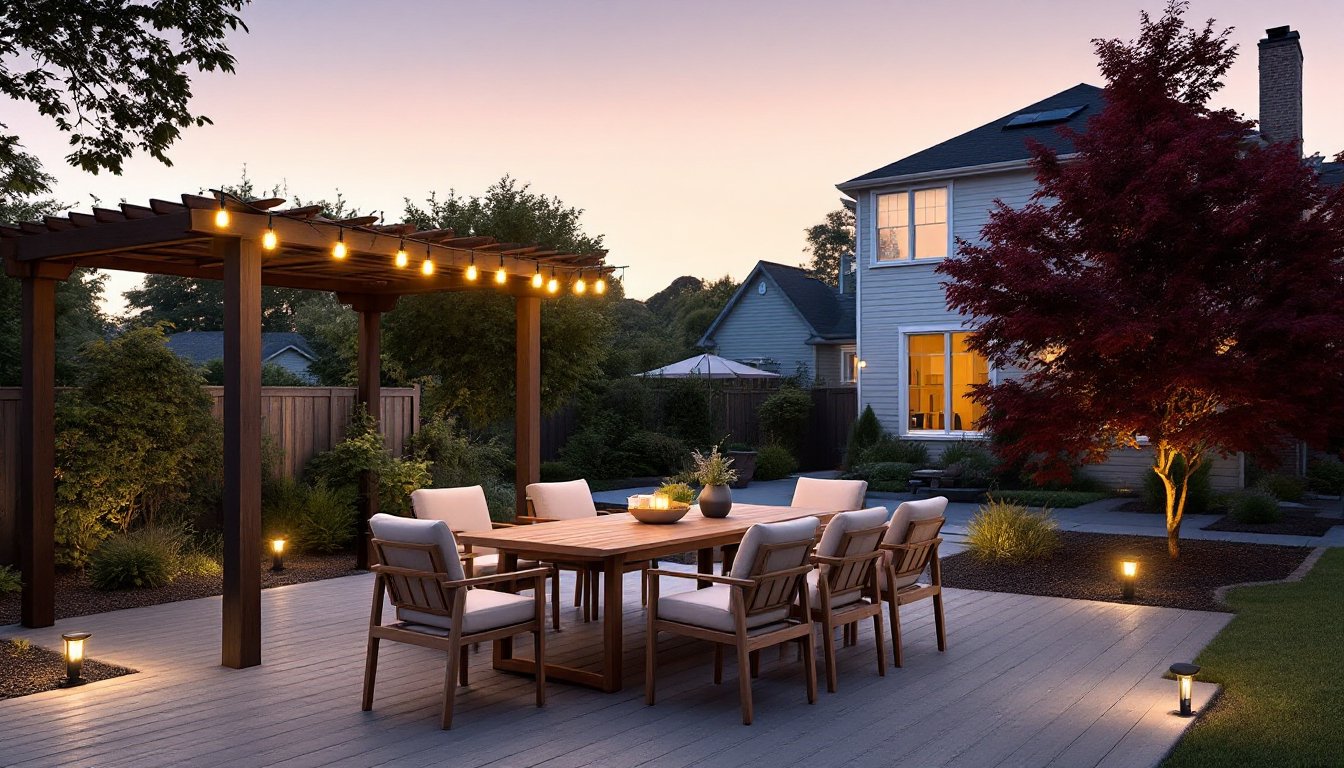
Solar string lights are the most popular choice for creating ambiance over dining areas, pergolas, and railings. Modern versions use Edison-style LED bulbs or globe diffusers spaced 12 to 18 inches apart on a weatherproof cord. The solar panel is usually a separate module connected by a lead wire, letting you mount the panel in full sun while draping the string in partial shade.
Look for strings rated IP65 or higher for water and dust resistance. Many outdoor lighting setups now feature dimmable solar strings with remote controls, giving you adjustable brightness without running a dimmer switch. Battery capacity is critical, cheaper models may only run three to four hours on a full charge, while quality units with 2,000+ mAh batteries can last eight hours or more.
Best placement: Overhead spans across patios, wrapped around pergola beams, or strung along fence lines. Avoid letting the string sag below 7 feet over walkways to prevent head strikes.
Pathway and Step Lights
These low-profile fixtures mount flush or nearly flush with the ground, providing safety lighting along patio edges, steps, and transitions to the yard. Most use a stake-mount design that pushes into soil or mulch, but deck-mount versions with screw-down bases are available for composite or wood surfaces.
Pathway lights typically emit 10 to 30 lumens per fixture, enough to mark a path without glare. For step lighting, choose models with downward-facing lenses to prevent light from shining into eyes as you descend. Some code jurisdictions (check your local IRC amendments) require step lighting for exterior stairs with three or more risers, though solar units usually meet the intent even if they’re not hardwired.
Best placement: Space path lights 6 to 8 feet apart along walkways. For steps, mount one fixture per riser on alternating sides, or use a single fixture at the top and bottom of short runs.
Spotlights and Accent Lighting
Solar spotlights deliver focused beams to highlight planters, architectural features, or specimen plants near the patio. Quality models produce 100 to 400 lumens and feature adjustable heads for precise aiming. According to smart home product reviews, higher-end solar spotlights now include motion-sensor modes that boost brightness when movement is detected, extending battery life during idle periods.
Many spotlights use adjustable color temperature LEDs, letting you choose between warm (2700K–3000K) and cool (4000K–5000K) light. Warm tones suit residential settings, while cooler light works for security-focused installations.
Best placement: Position spotlights 3 to 6 feet from the target, angling upward for trees or vertical surfaces. Avoid cross-lighting where two spots create competing shadows. If you’re lighting a water feature or sculpture, a single well-aimed spot often beats multiple weak lights.
How to Install Solar Lights on Your Patio
Installation varies by fixture type, but the process is straightforward for most homeowners.
For stake-mount path and accent lights:
-
Test panel placement first. Before driving stakes, set the light in its intended spot and observe the panel location. You need 4+ hours of direct sunlight on the panel for decent performance. If the fixture casts its own shadow on the panel or nearby structures block sun, reposition.
-
Prep the ground. If installing in compacted soil or clay, pre-drill a pilot hole with a 3/8-inch bit to avoid bending the stake. In mulch or loose soil, you can usually push the stake by hand.
-
Drive the stake. Insert the stake vertically, leaning fixtures look sloppy and reduce light effectiveness. Use a rubber mallet if needed, protecting the fixture housing with a scrap block of wood.
-
Adjust the panel angle. Most stakes have a swivel joint. Tilt the panel to face south (in the Northern Hemisphere) at an angle roughly equal to your latitude. For most of the continental U.S., that’s 30 to 45 degrees from horizontal.
For deck- and wall-mount fixtures (string lights, step lights):
-
Mount the solar panel. Choose a location with unobstructed southern exposure. Panels typically mount with two screws into a joist, rafter, or solid backing. Avoid mounting to fascia or thin trim that may pull away under wind load. Use stainless steel or coated deck screws to prevent rust.
-
Route the lead wire. Run the wire from panel to fixture along joist edges or under deck boards. Use cable staples or zip ties, but don’t crush the insulation. Leave slight slack to accommodate wood movement.
-
Secure the fixtures. String lights often hang from screw hooks or guide wires. Space hooks 2 to 3 feet apart for minimal sag. For step lights, mount flush to the riser or deck face, ensuring the lens is level so light distributes evenly.
-
Charge before first use. Let the battery charge for 24 to 48 hours in full sun before expecting normal runtime. Fresh batteries need a conditioning cycle.
Safety note: Even though solar lights operate at low voltage (typically 3.2 to 12V DC), you’re working at heights or near stairs. Wear safety glasses when drilling overhead, and use a stable ladder with a standoff if mounting to siding or eaves. If you’re uncomfortable working on a ladder, hire a handyman, it’s a quick job for someone with the right setup.
Most solar lights require no electrical permit since they’re not connected to building wiring. But, if you’re mounting fixtures to a structure (deck, pergola, or roof edge), ensure your fasteners hit solid framing. Pulling a composite deck board loose because you missed the joist is a common and annoying mistake.
Maximizing Performance: Placement and Maintenance Tips
Solar lights are low-maintenance, but they’re not no-maintenance. A few habits will keep them bright and reliable.
Panel cleanliness matters. Dust, pollen, bird droppings, and tree sap cut charging efficiency. Wipe panels monthly with a damp microfiber cloth, no harsh cleaners needed. In dusty or high-pollen areas, consider a quick spray-down with a garden hose every couple of weeks.
Battery lifespan is finite. Most solar lights use NiMH or lithium-ion batteries rated for 500 to 1,000 charge cycles, translating to roughly two to three years of service. When runtime drops noticeably even though clean panels and good sun exposure, it’s time to replace the battery. Many models use standard AA or 18650 cells available at hardware stores: check your manual before buying.
Avoid partial shade. Even a small shadow across part of the panel can cut output significantly due to how photovoltaic cells are wired in series. If a tree branch casts shade for part of the day, trim it back or move the light. Features highlighted in home automation guides often include solar fixtures with separate remote panels specifically to solve shading issues.
Winter performance. Snow covering the panel obviously stops charging. Brush it off after storms. Also, cold temperatures reduce battery capacity, a light that runs eight hours in July may only manage four in January, even with a full charge. This is normal lithium-ion and NiMH behavior, not a defect.
Lens clarity. Plastic lenses yellow and haze over time from UV exposure, cutting light output even if the LED is fine. Some fixtures have replaceable lenses: for others, you can try polishing with fine automotive rubbing compound or simply replace the whole fixture if it’s inexpensive.
Store off-season if needed. If you live where winter sun is weak or you close up the patio for months, bringing solar lights indoors extends their life. Store them with batteries removed to prevent leakage, and give them a full charge cycle in spring before reinstalling.
By matching the right fixture type to each zone of your patio, following straightforward installation steps, and keeping panels clean, solar lighting becomes a set-it-and-forget-it solution that genuinely works. No trenching, no electrician, no monthly costs, just reliable light exactly where you need it.