Outdoor lighting transforms curb appeal, boosts security, and extends usable hours in your yard, but what’s it going to cost? Whether you’re planning pathway lights, security floods, or accent lighting for your landscaping, installation prices vary widely based on fixture type, wiring complexity, and who does the work. This guide breaks down real-world costs for outdoor lighting projects in 2026, from low-voltage landscape kits to hardwired security systems. You’ll see what drives the price up, where you can DIY safely, and how to stretch your budget without cutting corners on safety or quality.
Table of Contents
ToggleKey Takeaways
- The cost of outdoor lighting installation ranges from $2,000 to $5,000 for most homeowners in 2026, with the national average around $3,500 for 8–12 fixtures and professional labor.
- Low-voltage landscape lighting systems are the most DIY-friendly and budget-friendly option, costing $200 to $600 per fixture installed, while line-voltage systems require a licensed electrician and cost significantly more.
- Wiring complexity, fixture quality, and labor rates are the primary cost drivers—upgrading from builder-grade fixtures ($15–$40) to architectural-grade brass or copper ($200+) and choosing 120V over 12V systems substantially increases total cost.
- You can save $800 to $2,000 in labor by DIY-installing low-voltage landscape lighting yourself over a weekend, but line-voltage and circuit work should always be left to licensed professionals to ensure safety and code compliance.
- Reducing outdoor lighting installation costs is achievable through tactics like doing your own trenching, sourcing fixtures separately, starting with a smaller system, and scheduling projects during off-season months when contractors offer 10–20% discounts.
Average Cost of Outdoor Lighting Installation
Most homeowners spend $2,000 to $5,000 on a complete outdoor lighting installation in 2026, with the national average landing around $3,500. That figure typically covers 8–12 fixtures, transformer or electrical work, and professional labor.
Low-end projects, like adding a single motion-sensor floodlight to an existing junction box, can run as little as $150 to $300 if you’re comfortable with basic electrical work. On the high end, comprehensive landscape lighting systems with 20+ fixtures, smart controls, buried conduit, and designer-grade fixtures can push $8,000 to $12,000 or more.
Key cost drivers include:
- Fixture count and quality: Builder-grade path lights run $15–$40 each: architectural-grade brass or copper fixtures can exceed $200 per unit.
- Wiring method: Low-voltage systems (12V or 24V) are cheaper and DIY-friendly. Line-voltage (120V) requires a licensed electrician in most jurisdictions and permits.
- Labor rates: Electricians charge $50 to $100 per hour depending on region. Landscape lighting specialists may charge $75 to $150 per hour but often work faster due to specialization.
- Site conditions: Rocky soil, existing hardscape, or long cable runs increase labor time and material costs.
Prices vary by region and market conditions. Always get at least three quotes and confirm whether the estimate includes permits, trenching, and a transformer or power supply.
Cost Breakdown by Lighting Type
Landscape and Garden Lighting
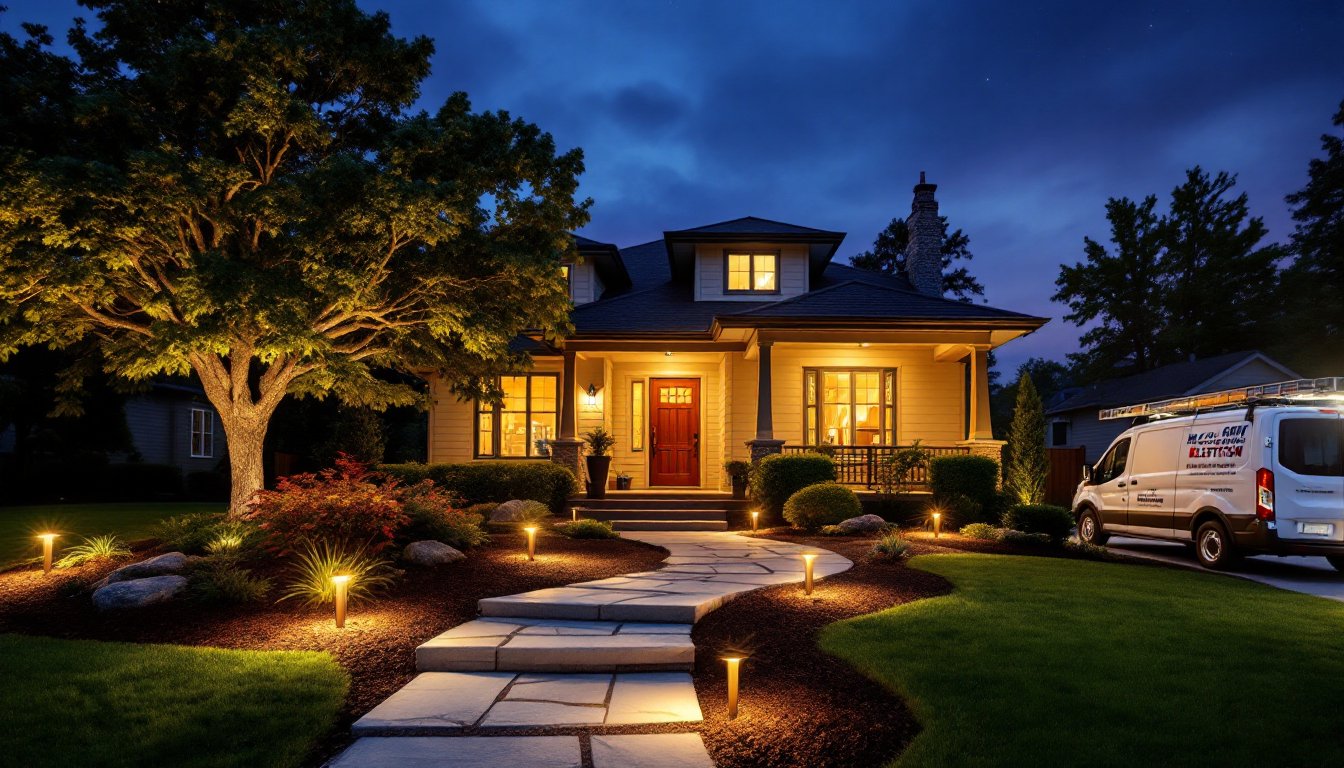
Low-voltage landscape lighting is the most popular choice for pathways, garden beds, and accent lighting. Expect to pay $200 to $600 per fixture installed, including the fixture, wiring, and labor. A typical 10-fixture system with a 300-watt transformer runs $2,500 to $4,500 professionally installed.
Materials breakdown:
- Transformer: $150–$400 (must match total wattage of all fixtures)
- 12V or 24V fixtures: $20–$250 each (LED path lights, spotlights, well lights)
- Cable: 12/2 or 14/2 low-voltage wire, roughly $0.30–$0.60 per foot
- Connectors and stakes: $50–$100 for a typical system
DIY kits from big-box stores start around $150 to $300 for 6–8 basic fixtures and a transformer, but fixture quality and longevity often suffer. For a system that lasts 10+ years, invest in solid brass or copper fixtures with replaceable LED modules.
Hardwired landscape systems (rare) run $3,000 to $6,000 due to conduit burial, junction boxes, and electrician labor. They’re overkill for most residential applications.
Security and Motion-Sensor Lights
Motion-sensor floodlights and security lighting typically cost $100 to $500 per fixture installed, depending on whether you’re adding to an existing circuit or running new wiring.
Breakdown by installation type:
- Replacing an existing fixture (porch light, garage light): $75–$200 DIY: $150–$350 with an electrician
- Adding a new fixture to an existing circuit: $200–$500 (includes running cable, junction box, and fixture)
- New circuit from the panel: $500–$1,200 (requires breaker, conduit run, possibly a permit)
Popular fixture types and costs:
- Basic halogen or LED floodlight with PIR sensor: $25–$80 (fixture only)
- Smart security lights (Wi-Fi, camera-equipped): $100–$300 (fixture only)
- Dusk-to-dawn fixtures: $30–$120
Most municipalities require a permit for new 120V circuits. Budget $50 to $200 for the permit, and expect inspection. If you’re uncomfortable working inside a live panel, hire a licensed electrician, this isn’t the place to learn on the job.
Solar-powered security lights avoid wiring costs entirely but provide inconsistent performance in shaded or cloudy climates. They’re best for supplemental lighting, not primary security.
Factors That Affect Installation Costs
Wiring complexity is the single biggest variable. Low-voltage systems use simple two-conductor cable you can bury a few inches deep or run through mulch beds. Line-voltage systems require UF-B cable (underground feeder) in conduit, often 18–24 inches deep per National Electrical Code (NEC) standards. Trenching alone can add $3 to $8 per linear foot if you hire it out.
Transformer or power supply location matters. If your transformer can mount near an existing outdoor GFCI outlet, installation is straightforward. If you need to add a dedicated circuit or relocate the transformer 50+ feet from the panel, expect $300 to $800 in additional electrical work.
Fixture spread and cable runs: The farther fixtures are from the transformer, the heavier the gauge wire you’ll need to prevent voltage drop. According to landscape lighting installation cost data, runs over 100 feet often require 10/2 low-voltage cable instead of 12/2, raising material costs by 30–50%.
Terrain and obstacles: Hardscape (pavers, concrete, existing decks) requires routing around or boring under, adding labor hours. Rocky or clay-heavy soil slows trenching. Tree roots can require hand-digging or special tools.
Smart controls and automation: Adding a smart lighting controller or integrating with existing home automation systems (Z-Wave, Zigbee, Wi-Fi) adds $150 to $500 in hardware and programming time.
Permits and inspections: Required for any new 120V circuits in most jurisdictions. Budget $50 to $200 for the permit, and factor in scheduling delays for inspection.
Seasonal demand: Electricians and landscape lighting pros are busiest in spring and early summer. Off-season scheduling (late fall, winter) can sometimes yield 10–15% lower labor rates.
DIY vs. Professional Installation: Which Saves More?
Low-voltage landscape lighting is the most DIY-friendly option. If you’re comfortable with basic hand tools and can follow a wiring diagram, you can install a 10-fixture system in a weekend and save $800 to $2,000 in labor. Total DIY cost: $400 to $1,200 for quality fixtures, transformer, and cable.
Tools you’ll need:
- Spade or trenching shovel (or rent a powered trench edger for $50–$80/day)
- Wire strippers and cutters
- Voltage tester (essential for checking transformer output)
- Drill with masonry bit (if mounting transformer to brick or stucco)
Challenges to expect: calculating voltage drop, sizing wire correctly for long runs, and achieving even light distribution. Most low-voltage systems are forgiving, there’s no shock hazard once the transformer steps down to 12V, but poor wire sizing leads to dim fixtures at the end of the run.
Line-voltage (120V) installations are a different story. Unless you’re an experienced DIYer who’s worked inside a breaker panel and understands NEC code, hire a licensed electrician. Mistakes can cause fire, shock, or code violations that complicate future home sales. Professional installation for a new 120V security light circuit costs $500 to $1,200, but it’s permitted, inspected, and insured.
Gray area: replacing an existing 120V fixture (swapping an old porch light for a new motion-sensor model) is a common DIY task if the wiring is in good shape. Always turn off the breaker, test for voltage, and check local codes, some jurisdictions require permits even for fixture replacement.
When to call a pro:
- Any work inside the main service panel
- New circuits requiring conduit or trenching under driveways
- Systems with more than 15 fixtures (design and load calculations get complex)
- Integration with existing home automation or landscape irrigation systems
Pros also carry liability insurance. If a DIY wiring mistake causes a fire, your homeowner’s policy may deny the claim.
How to Reduce Your Outdoor Lighting Installation Costs
Do your own trenching. Digging cable channels is labor-intensive but not technical. Offer to trench yourself and save $200 to $800 on a typical installation. Just follow the pro’s layout and depth specs.
Buy fixtures separately. Contractors often mark up fixtures 30–50%. Source your own from reputable online retailers or wholesale distributors, then pay the installer for labor only. Confirm they’ll warranty the work even with customer-supplied materials.
Start with a smaller system. Install 6–8 key fixtures now (entry path, driveway, front door) and expand later. Most low-voltage transformers have extra capacity. Adding fixtures to an existing system costs only the fixture price plus an hour or two of labor.
Use solar for supplemental areas. Solar path lights and accent lights have improved dramatically. They won’t match hardwired performance, but for secondary walkways or garden beds, they’re a budget-friendly add-on.
Choose LED fixtures from the start. Initial cost is higher, but LED modules last 25,000–50,000 hours vs. 2,000–4,000 for halogens. You’ll save on replacement bulbs and transformer sizing (LEDs draw 1/5 the wattage).
Get multiple quotes and ask for itemization. Platforms like HomeAdvisor and ImproveNet connect homeowners with local contractors and provide cost benchmarks. Compare fixture costs, labor rates, and warranty terms.
Time your project. Off-season installation (late fall, winter) can yield discounts from contractors with lighter schedules. Weather may slow work, but savings of 10–20% can be worth it.
Skip the bells and whistles initially. Timers, photocells, and smart controls are nice but not essential. A basic transformer with a manual switch works fine: add automation later if desired.
Maintain your system. Clean fixtures annually, check connections, and trim vegetation. Neglected systems fail early, costing more in the long run than a little preventive care.