Modern kitchens demand both function and clean lines. Low profile under cabinet lighting delivers task lighting exactly where prep work happens without bulky fixtures stealing visual space or clashing with contemporary design. Unlike traditional fluorescent bars that hang down or chunky puck lights that protrude, low-profile options tuck tight against the cabinet bottom, often less than half an inch thick. They eliminate shadows on countertops, boost visibility for chopping and cooking, and create ambient glow that makes the whole kitchen feel more inviting. Whether retrofitting an existing kitchen or wiring a new build, understanding the options helps homeowners pick fixtures that actually fit their space and skill level.
Table of Contents
ToggleKey Takeaways
- Low profile under cabinet lighting mounts flush beneath cabinets at 1/2 inch thick or less, eliminating shadows on countertops while maintaining clean kitchen aesthetics.
- LED technology powers most modern low-profile fixtures, offering 25,000–50,000 hour lifespan and consuming only 3–8 watts per foot—a significant energy savings compared to halogen or incandescent alternatives.
- LED strip lights provide the thinnest option and simplest installation for homeowners, using adhesive backing and plug-in drivers, while linear bars deliver more even task lighting but require professional wiring in most cases.
- Aim for 200–400 lumens per linear foot of cabinet for optimal task lighting, and choose neutral white (3500K–4000K) for balanced kitchen lighting that accurately renders food colors.
- Proper surface preparation with rubbing alcohol and firm adhesive application ensures long-term durability of low-profile strips, while hardwired installations require junction boxes, proper wire gauges, and compliance with local electrical codes.
What Is Low Profile Under Cabinet Lighting?
Low profile under cabinet lighting refers to any fixture designed to mount flush or nearly flush beneath wall cabinets, typically measuring 1/2 inch thick or less. The goal is illumination without intrusion, lights that don’t hang down, don’t break the visual line between counter and cabinet, and don’t bump your head when you lean in to clean.
These fixtures come hardwired or plug-in, in lengths from 6 inches to 48 inches, and run on standard 120V household current or low-voltage systems (12V or 24V). Low-voltage options require a transformer (often called a driver), which can hide inside a cabinet or in the basement, depending on wire runs.
Most low-profile lights use LED technology, which runs cool, lasts 25,000–50,000 hours, and draws a fraction of the power compared to older halogen or xenon strip lights. The slim form factor is possible because LEDs generate far less heat and require minimal housing.
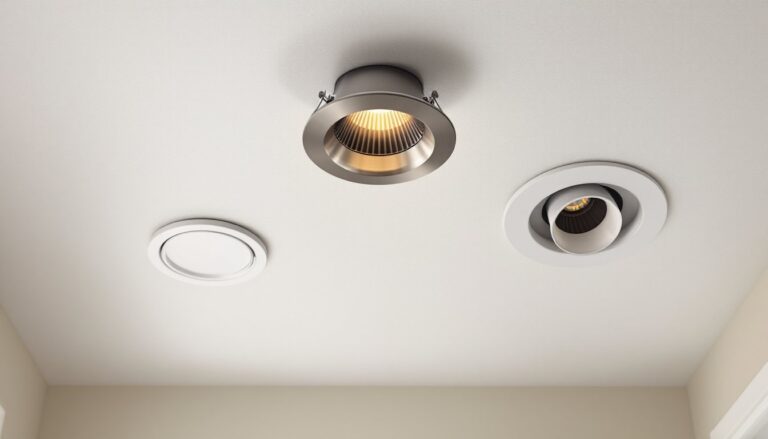
They’re distinct from recessed puck lights, which recess into the cabinet bottom (requiring drilling large holes), and from traditional linkable fluorescent bars that typically measure 1–2 inches thick and extend below the cabinet.
Why Choose Low Profile Lighting for Your Cabinets
Visual Clean-Up: Standard under-cabinet fixtures are visible from across the room and can look dated fast. Low-profile strips and bars disappear from most sightlines, especially in kitchens with taller upper cabinets or when viewed from seating areas.
Better Task Lighting: These fixtures sit closer to the work surface and spread light more evenly across the counter. That reduces hot spots and glare compared to individual puck lights spaced far apart.
Easier Retrofit: Thin profiles mean less clearance needed between the cabinet bottom and backsplash. That’s a big deal in kitchens where tile, outlets, or decorative trim already crowd the space. Many plug-in strip kits install with adhesive backing and require zero electrical work, just peel, stick, and plug in.
Energy Efficiency: LED low-profile lights typically draw 3–8 watts per foot, translating to pennies per month in energy cost. Compare that to older halogen or incandescent systems that could pull 20+ watts per foot and get hot enough to discolor cabinet finishes.
Flexibility: Because they’re compact and lightweight, low-profile fixtures work in tight spots: inside glass-front cabinets, under floating shelves, even inside closets or pantries. Homeowners looking for versatile kitchen design solutions often turn to low-profile LEDs for accent and task lighting in multiple rooms.
Types of Low Profile Under Cabinet Lights
LED Strip Lights
LED strip lights (also called tape lights or ribbon lights) are the thinnest option available, often 1/4 inch thick or less. They come on a flexible circuit board with adhesive backing, sold by the foot or in kits with preset lengths.
Pros: Ultra-low profile, bendable around corners, cuttable at marked intervals (usually every 2–4 inches), and available in color-changing RGB versions for accent lighting. Plug-in kits are dead simple: stick the strip, run the cord to an outlet, done.
Cons: Lower-end strips can show individual LED “dots” instead of a smooth line of light, especially on glossy countertops. Look for high-density strips (120+ LEDs per meter) or models with diffuser channels to eliminate hotspotting. Strips also require a separate power supply (driver), which adds a small box to hide somewhere.
Installation tip: Clean the cabinet bottom with rubbing alcohol before applying adhesive. Grease and dust kill stick. For permanent installs, add a bead of clear silicone along the strip edge every 12 inches, it reinforces the bond and prevents sag over time.
Puck Lights and Linear Bars
Puck lights are small, round fixtures (usually 2–3 inches in diameter) that sit flat against the cabinet. Linear bars are rigid, enclosed housings, think metal or plastic channels 6–48 inches long and roughly 3/8–1/2 inch thick.
Pros: Linear bars produce more even light than individual pucks and often include built-in diffusers for a softer glow. Many low-voltage systems link together with snap connectors, so one driver can power multiple bars. Pucks work well for spot lighting or when cabinet runs are broken up by a range hood or open shelving.
Cons: Pucks can create scalloped light patterns with dark gaps between fixtures. Linear bars cost more per foot than basic LED strips but deliver better light quality and durability. Hardwired versions require a junction box and may need an electrician unless you’re comfortable with basic wiring and your local code allows homeowner electrical work.
Installation tip: When linking multiple bars, calculate total wattage and confirm the driver can handle the load. A 60-watt driver won’t safely power four 20-watt bars. Also check the amperage rating on the wire connectors, underpowered connectors get warm and fail early.
How to Install Low Profile Under Cabinet Lighting
Safety first: If hardwiring, shut off power at the breaker and verify it’s off with a non-contact voltage tester. Wear safety glasses when drilling overhead.
Plug-In Strip Light Installation (Easiest)
- Measure and plan: Run a tape measure along the cabinet bottom. Mark outlet locations and note any obstacles (trim, outlets, tile edges). Cut strips to length at the marked cut points if your kit allows.
- Prep the surface: Wipe the cabinet underside with rubbing alcohol and let dry. Any grease or residue will prevent adhesive from sticking.
- Apply the strip: Peel a few inches of backing at a time, press firmly, and smooth out bubbles. Don’t pull the strip taut, leave slight slack to prevent peeling over time.
- Route the cord: Use adhesive cord clips or small staples to run the power cord along the cabinet edge to the nearest outlet. Keep cords away from the stovetop and sink.
- Plug in and test: Flip the switch or press the remote. If sections are dim or don’t light, check connections and verify the driver is rated for the total strip length.
Hardwired Linear Bar Installation (Intermediate)
- Plan your circuit: Determine whether you’ll tie into an existing switch or install a new one. Some homeowners prefer a dedicated dimmer switch for under-cabinet lights.
- Install a junction box: If one isn’t already present, mount a pancake-style junction box inside the cabinet or on the wall above. Make sure it’s anchored to a stud or blocking, not just drywall.
- Run wire: Pull 14/2 NM cable (for 15-amp circuits) or 12/2 (for 20-amp) from the switch to the junction box. Follow NEC guidelines for stapling and protection. Most jurisdictions require a permit for new circuits, check local code.
- Mount the fixtures: Screw the linear bars to the cabinet bottom using the provided hardware. Space screws every 12–16 inches to prevent sagging.
- Wire the connections: Connect hot (black), neutral (white), and ground (bare copper) using wire nuts rated for the gauge. If linking multiple bars, daisy-chain them according to the manufacturer’s diagram. Cap all splices and tuck wires neatly into the junction box.
- Test before closing up: Restore power and verify every bar lights up. If one section is dark, recheck the connections at that fixture.
Pro tip: Label the breaker when you’re done. Future you, or the next owner, will appreciate knowing which switch controls the under-cabinet lights.
For complex layouts or if your cabinets don’t have an accessible run back to the panel, consider hiring a licensed electrician. Most charge $100–$300 for a straightforward under-cabinet install, depending on region and wire runs required.
Choosing the Right Brightness and Color Temperature
Lumens Matter More Than Watts: LED efficiency varies, so focus on lumens per foot instead of wattage. For task lighting over countertops, aim for 200–400 lumens per linear foot of cabinet. Lower values work for ambient or accent lighting: higher lumens suit detailed prep work or aging eyes.
Color Temperature: Measured in Kelvin (K), this dictates the “warmth” of the light.
- 2700K–3000K (Warm White): Cozy, similar to incandescent bulbs. Works well in traditional kitchens or homes where evening ambiance matters more than surgical precision.
- 3500K–4000K (Neutral White): Balanced, closer to natural daylight. Popular in contemporary kitchens and recommended by many design experts for accurate color rendering when cooking.
- 5000K+ (Cool White): Crisp and bright, almost clinical. Good for workshops or task-heavy spaces, but can feel harsh in residential kitchens.
Dimming: Not all LED strips and bars are dimmable. If you want dimming, verify compatibility between the fixture, driver, and dimmer switch. ELV (electronic low-voltage) dimmers usually work best with LED drivers: standard incandescent dimmers can cause flickering or buzzing.
CRI (Color Rendering Index): A measure of how accurately colors appear under the light. Look for a CRI of 90+ if you care about food looking natural or matching paint samples. Lower-CRI LEDs can make reds look muddy and greens washed out.
Testing Before Commitment: Many online retailers and home centers accept returns on lighting, so order a sample strip or bar, test it under your cabinets at night and during the day, and see how it feels. What looks perfect in a showroom might feel too blue or too dim in your actual kitchen.